
Kitchen cabinet laminate repair Toronto homeowners ask about is one of those jobs that sounds simple—until you pull back the peeling edge and realize the scope of the problem. A condo owner in downtown Toronto recently called us about cabinets where the laminate coating was lifting away from the bottom edge, exposing raw particleboard underneath. It looked fixable, and in her case, it was: a straightforward re-glue job that cost $150 and took less than an hour. But laminate peeling isn’t always that clean. Sometimes it signals deeper damage that no amount of adhesive will solve.
The difference between a quick fix and a cabinet replacement often comes down to one thing: how much damage exists beneath the surface. This guide walks you through what causes laminate to peel, how to assess whether yours is salvageable, and when to call a professional handyman instead of trying a DIY repair that might make things worse.
Why Kitchen Cabinet Laminate Peels (Especially in Toronto Condos)
Toronto’s climate is hard on kitchen cabinets. Winter heating dries the air; summer humidity swells particleboard and loosens adhesive bonds. Most laminate—the plastic veneer bonded to cabinet faces and edges—relies on contact cement or PVA adhesive to stay put. Both degrade over time, especially in temperature-swinging condo kitchens where the air changes from bone-dry to damp in a single day.

Edge laminate is the first casualty. It takes the most physical contact: hands grabbing cabinets, water splashing during cleaning, the constant micro-flexing of cabinet doors opening and closing. The adhesive underneath weakens, and the laminate begins to curl up. If the cabinet is older than 15 years—or if it was made with cheaper adhesive to begin with—peeling often spreads quickly once it starts.
Particleboard itself is vulnerable. Unlike solid wood, it absorbs moisture like a sponge and swells unevenly. When laminate peels away, the exposed particleboard often swells or warps, making re-gluing harder and sometimes impossible. In humid Scarborough kitchens or moisture-prone Mississauga condos, this happens faster. Heat also plays a role: cabinets above or near a stove see more adhesive breakdown than those across the room.
How to Tell If Your Laminate Is Worth Repairing
Before you grab a glue gun, assess the damage. There’s a big difference between a small edge peel and widespread delamination, and knowing the difference saves money and headache.
Edge Peel (Repairable)
Edge peeling is exactly what it sounds: the laminate coating the front or side edge of a cabinet door or face is curling up, usually no more than 1–2 inches along the edge. The substrate underneath—the particleboard or plywood—is still flat and dry. When you gently press the laminate back down, it sits flush. This is the ideal repair candidate. A handyman can scrape out the old adhesive, clean the surface, apply fresh contact cement, press it down, and clamp it for 24 hours. Cost in Toronto ranges from $100–$200 per cabinet door, depending on the size and how many edges need work.
Full Delamination (Often Not Worth Fixing)
Full delamination means the laminate has separated from a large section of the substrate—sometimes the entire face of a door. The substrate often swells or warps when exposed to air and moisture. Even if you re-glue it, the particleboard won’t compress back to its original shape. The laminate will bubble or wrinkle, and the repair fails within months. Replacement is the only reliable fix.
Signs of Substrate Damage (Stop and Replace)
- Soft or spongy particleboard: Press your thumbnail into the exposed substrate. If it dents or feels waterlogged, moisture damage is advanced. Repair won’t hold.
- Warped laminate: If the laminate itself is bent or wavy before peeling, the substrate has already shifted. Gluing it back creates a buckled surface.
- Discoloration or dark spots: These indicate mold or water damage. Repair risks spreading contamination and is a health concern.
- Laminate cracking or brittle edges: Old laminate that’s yellowed and breaks apart easily won’t bond securely again, even with fresh adhesive.
- Peeling that spans more than 30% of the cabinet face: At this point, structural integrity is compromised. Replace the door or cabinet.
If you’re unsure, a free estimate from a Toronto handyman takes the guesswork out. Get a quote and let a professional assess whether re-gluing makes sense or whether replacement is the smarter long-term choice. In the case of Janet’s kitchen in downtown Toronto, the laminate was only peeling at one edge, the substrate was solid, and she was satisfied with a straightforward repair—exactly the scenario where gluing it back down works.
How Kitchen Cabinet Laminate Repair Actually Works
Laminate peeling from kitchen cabinets is one of the most common repairs we handle in Toronto—and when caught early, it’s straightforward. The process relies on four core steps: cleaning, adhesive application, clamping, and curing.
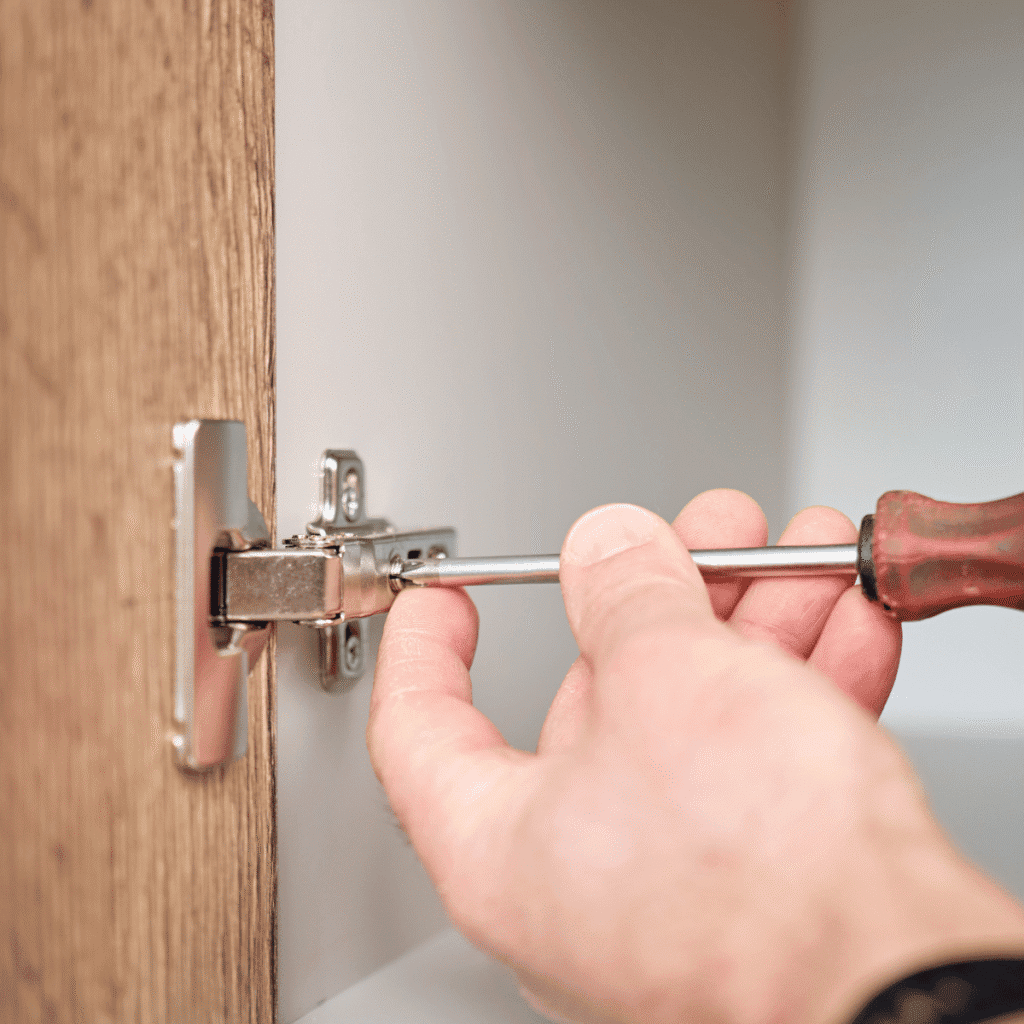
Most peeling comes from heat and steam, so we check the area around the stove, kettle and dishwasher first. Adhesive choice matters too; contact cement rated for laminate, used as the laminate manufacturer recommends, gives a far stronger bond than all-purpose glue.
Step 1: Clean the Surface
The first move is stripping away any old adhesive, dirt, or moisture underneath the peeling laminate. We use a scraper or putty knife to lift the edge gently and remove buildup without damaging the veneer or substrate. A dry surface is non-negotiable—wet glue won’t bond properly.
Step 2: Apply the Right Adhesive
We use contact cement or high-strength wood adhesive (typically polyurethane-based like DAP fast-set wood glue). Contact cement requires both surfaces to be coated and left until tacky before joining. Polyurethane adhesive bonds faster and is more forgiving if you need to reposition slightly. For edge regluing, contact cement is the faster choice and sets in minutes.
Step 3: Clamp and Press
Once adhesive is applied, the laminate is pressed firmly back against the cabinet substrate. We use C-clamps, bar clamps, or weight (stacked books, blocks) to maintain even pressure across the entire edge. Uneven clamping leaves air pockets and weak spots.
Step 4: Cure Properly
Curing times vary: contact cement bonds in 30 seconds to 2 minutes; polyurethane adhesive needs 4–24 hours depending on the product. During this time, the joint must remain undisturbed and under pressure. Once cured, we sand smooth any raised edges and apply finish if needed.
This is exactly the work Janet needed at her condo in Toronto—a straightforward reglue of peeling cabinet laminate. When you catch the problem early and the substrate isn’t swollen or damaged, it’s a reliable fix. Our handyman service handles these repairs same-day throughout Toronto and the GTA.
Kitchen Cabinet Laminate Repair Toronto Cost Guide (2026)
Laminate repair pricing in Toronto depends on the scope: whether you’re regluing an edge, patching a gouge, recovering a single door, or replacing it outright. Below is a real-world cost breakdown in CAD based on current Toronto market rates and our 7+ years of experience.
| Repair Type | Typical Cost (CAD) | Time to Complete | Best For |
|---|---|---|---|
| Edge Reglue (1–2 edges, small cabinet) | $100–$200 | 30 min–1 hr | Fresh peeling, good substrate |
| Small Patch or Spot Repair | $150–$250 | 1–1.5 hrs | Chips, small burns, minor gouges |
| Single Door Laminate Recover | $300–$600 | 2–3 hrs | Widespread peeling, discoloration on one door |
| Full Cabinet Face Relaminate | $800–$1,500+ | 1–2 days | Severe damage, multiple doors, entire run |
| Cabinet Replacement (per unit) | $1,200–$3,500+ | 1 day (install) | Structural damage, outdated style, beyond repair |
Why Price Varies
Cabinet accessibility, substrate condition, laminate color match, and whether the rest of your kitchen needs updating all affect the final bill. A peeling edge on a 10-year-old cabinet in Markham costs less to glue than recovering a full door that has water damage, swelling, or mismatched laminate. If the substrate (usually MDF or plywood) is swollen, soft, or warped, we often recommend replacement rather than repair—adhesive alone won’t restore stability.
Janet’s repair—a simple edge reglue at her Toronto condo—fell into the $100–$200 range, which is exactly what she agreed to. We always provide free estimates so you know the cost upfront. If a larger job emerges (like cabinet replacement), we’ll show you the options and let you decide.
DIY vs. Hiring a Pro for Kitchen Cabinet Laminate Repair Toronto
If the laminate is cleanly peeling at one edge—and the core is solid—many homeowners in Toronto and the GTA can handle the glue-down themselves. You’ll need contact cement or cabinet adhesive, a clean cloth, and clamps or weights. The job takes 15–30 minutes plus cure time, usually overnight.
You should hire a professional if the laminate is cracked, bubbling across a large area, or if the substrate (the plywood or MDF underneath) is swollen, soft, or water-damaged. Moisture damage spreads fast in kitchens. Attempting a quick fix on compromised substrate often wastes money and ends up back on your to-do list. RenoHeal’s kitchen service team assesses the damage at no charge and can often complete straightforward cabinet repairs the same day, like the laminate re-gluing and latch replacement we handled for a client in downtown Toronto.
Another reason to call a pro: if the laminate covers a visible front edge, the glue-down needs to be perfectly aligned and flush. Misalignment or wrinkles are hard to hide on a cabinet face. Our technicians have the experience to ensure the result looks factory-done.
Common Mistakes That Make Peeling Laminate Worse
Using the wrong adhesive is the leading culprit. Wood glue, super glue, or hot-melt gun adhesive won’t hold laminate long-term under kitchen heat and humidity. Contact cement and two-part epoxy are the standards; contact cement dries fastest and is easier for DIY.
Skipping the clean step costs you a permanent fix. Dust, grease, and old dried adhesive prevent new glue from bonding. Wipe both the laminate back and the substrate with a damp cloth, let dry completely, then wipe again with a tack cloth to catch fine dust.
Not clamping or weighting the repair leads to gaps and lifted edges. Apply glue, press the laminate down firmly, then use bar clamps, C-clamps, or heavy books to hold pressure for the full cure time—usually 12–24 hours depending on the adhesive. Rushing and using your cabinet before the glue sets causes the repair to fail within weeks.
Ignoring water stains or discoloration near the peel often signals moisture already in the substrate. A cosmetic glue-down won’t solve this. If you spot swelling, soft spots, or mold smell, the cabinet may need reinforcement or replacement—something our team diagnoses on site during a free estimate.
What Happens If You Ignore Peeling Cabinet Laminate
Peeling laminate might look like a small cosmetic issue, but ignoring it creates real problems. Water and moisture slip underneath the laminate layer and into the MDF (medium-density fiberboard) core of your cabinet. MDF absorbs water like a sponge, swelling and warping as it does.

If repair is not worth it, our cabinet installation team can replace individual doors or boxes. We handle kitchen cabinet laminate repair Toronto-wide, including condo kitchens downtown, in North York and in Etobicoke.
Once MDF absorbs moisture, it loses structural integrity. The cabinet can weaken, drawers stop closing properly, and doors sag. You’ll also notice swelling at the cabinet base—exactly what Janet experienced at her Toronto condo.
Moisture also creates ideal conditions for mold and mildew growth inside the cabinet, especially in kitchens where humidity is already high. Mold can spread to adjacent cabinets and, over time, become a health concern for your home.
The cost escalates quickly. A $150 laminate repair today can become a $800–2,500 cabinet replacement in six months if the core deteriorates beyond repair. Small fixes done early are always cheaper than waiting for structural damage.
If you’ve got peeling laminate in Toronto or the GTA, get a free estimate before moisture damage spreads.
Frequently Asked Questions
Can you glue peeling cabinet laminate back down, or does the whole door need replacing?
In many cases, yes — if the laminate is lifting at an edge or corner but the substrate underneath is still dry and structurally sound, a technician can reglue it cleanly and the repair holds well. The whole door typically needs replacing only when the laminate has peeled across a large area, the MDF beneath has swollen or crumbled, or the surface is so wavy that regluing would leave visible bubbles. A quick in-person assessment takes the guesswork out of it.
How much does kitchen cabinet laminate repair cost in Toronto?
For a straightforward edge or corner reglue on one or two doors, expect to pay roughly $80–$180 CAD for a professional repair visit in Toronto. If multiple doors need attention, full refacing, or substrate patching, costs can range from $300 to $900+ depending on the scope and cabinet count. Getting a free on-site estimate is the most reliable way to pin down your specific cost before committing.
What type of glue works best for reattaching cabinet laminate?
Contact cement (solvent-based or water-based) is the industry standard for bonding laminate back to MDF or particle board — it creates a strong, flexible bond that handles kitchen humidity reasonably well. For small edge lifts, a high-quality PVA wood glue or a dedicated laminate repair adhesive with a clamp can also work. Avoid standard super glue or construction adhesive; they’re too rigid and usually fail within months under the heat and moisture cycles of a kitchen.
How long does a laminate repair last before it peels again?
A properly done repair — clean surfaces, correct adhesive, adequate clamping time — can last five years or longer, especially on doors away from heat and steam sources. Repairs near the dishwasher, sink, or stove tend to have a shorter lifespan because of ongoing moisture exposure. If the same spot keeps peeling, the underlying substrate is likely compromised and replacement is the more cost-effective long-term choice.
Is peeling laminate covered by condo building insurance or a home warranty?
Standard condo building insurance policies in Ontario cover sudden and accidental damage — peeling laminate from normal wear and humidity is almost never included. Some new-build home warranties under Tarion cover defects in materials or workmanship within the first year, so if your kitchen is relatively new, it’s worth reviewing your Tarion documentation. For older kitchens or resale condos, this repair is typically an out-of-pocket cost.
How do I know if my cabinet substrate (MDF or particle board) is damaged underneath the laminate?
Press gently on the area where the laminate has lifted — if the surface feels soft, spongy, or crumbles slightly under light pressure, the substrate has absorbed moisture and is breaking down. Visible swelling, a raised or warped door surface, or a white chalky residue under the laminate are also reliable signs of substrate damage. When the core material is compromised, regluing the laminate is a temporary fix at best; door replacement or refacing is the right call.
Kitchen Cabinet Laminate Repair in Toronto: Know When to Repair and When to Replace
Peeling cabinet laminate is one of those problems that looks worse than it often is. A small lift at the edge of a door, caught early, is usually a straightforward fix — the right adhesive, proper surface prep, and clamping time are all it takes. The repair blends in, holds up, and costs a fraction of new doors.
The situation changes when moisture has already reached the MDF or particle board underneath. Once the substrate swells or softens, no amount of regluing will give you a lasting result. In those cases, replacing the door or refacing the cabinet run is the smarter investment — and knowing that distinction upfront saves you from paying for a repair twice.
If you’re not sure which category your cabinets fall into, RenoHeal’s technicians can assess the damage on-site and give you an honest answer. Request a free quote today, or learn more about our full range of kitchen services in Toronto.